
Ngorongoro Crater The Eighth Wonder of the Natural World
April 1, 2026
A Safari Guide to Nairobi National Park
April 23, 2026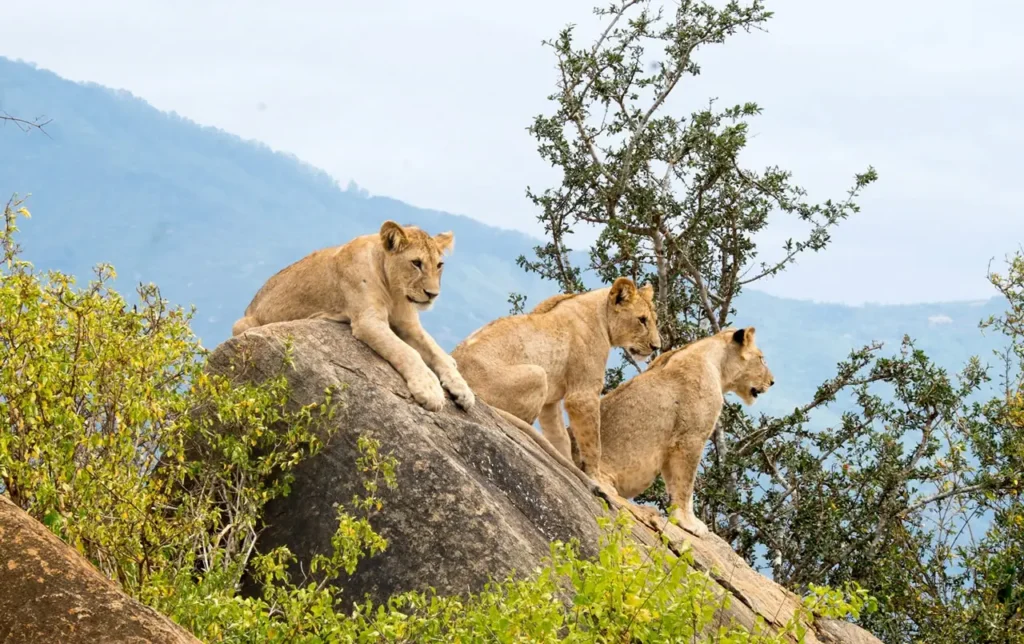
Tsavo National Park
There is a moment, if you are lucky, if the dust settles just right at golden hour, when the landscape of Tsavo seems to breathe. The acacia trees stand silhouetted against a sky burning tangerine and violet. A lioness lifts her head from the grass, unblinking. And somewhere beyond the lava plateau, a herd of elephants rust-red from their daily wallowing moves in slow procession toward the river. This is Tsavo. Ancient, vast, untamed.
Welcome to one of Africa’s greatest wildlife sanctuaries and arguably Kenya’s most underrated safari destination. At Otter African Safaris, we believe Tsavo deserves to be spoken of in the same breath as the Masai Mara. Here is why.
-
22,000 km² combined area.
-
1948 Year established.
-
500+ Bird species.
-
Big 5: All present.
Two Parks, One Wild Soul
Separated by the Nairobi–Mombasa highway, a road that itself tells a story, slicing through wilderness that has existed for millennia, Tsavo East and Tsavo West are siblings with dramatically different personalities. Together, they form one of the largest conservation areas on the planet, covering roughly 22,000 square kilometres. To put that in perspective: Tsavo West alone is larger than Wales.
Tsavo East
The Open Kingdom
- Vast open savannah plains.
- Iconic red dust elephants.
- Galana River wildlife corridor.
- Mudanda Rock viewpoint.
- Lugard’s Falls on the Galana.
- Yatta Plateau lava flow.
Tsavo West
The Layered Wilderness
- Volcanic hills & dense bush.
- Crystal Mzima Springs.
- Ngulia Rhino Sanctuary.
- Shetani Lava Flow & caves.
- Chyulu Hills walking safaris.
- Hippos & crocodiles at springs.
Tsavo East is the classic “big sky, big herds” experience, open country where wildlife is seen across sweeping panoramas, where your eyes travel to the horizon and never hit a fence. Tsavo West, by contrast, is rugged and layered: a landscape of volcanic hills, dense pockets of vegetation, and geological drama that unfolds at every turn. Choosing between them is like choosing between two extraordinary chapters of the same novel. At Otter African Safaris, we say: read both.
“Tsavo is not one park. It is a world. And like all great worlds, it rewards those who take the time to get properly, beautifully lost in it.”
The Legend of the Red Elephants
If Tsavo has one icon above all others, it is the elephant, specifically, the rust-red elephant. Found nowhere else on Earth in quite this form, these are ordinary African savannah elephants who have developed an extraordinary habit: rolling and wallowing in the park’s distinctive iron-rich red soil until their grey skin is painted the colour of the earth itself.
Watch them at Mudanda Rock, a great granite whale-back that rises from the plains and channels runoff into a natural dam below. In the dry months, hundreds of elephants converge here to drink, jostling gently, spraying water, youngsters tucking under their mothers’ bellies. It is one of the most moving wildlife spectacles in all of Kenya, and it costs nothing but time and patience.
Tsavo is home to some of Kenya’s largest elephant herds. Decades of conservation work, anti-poaching patrols, and modern surveillance have seen elephant numbers recover from historic lows to a thriving, protected population. When you visit Tsavo on an Otter African Safaris itinerary, you are witnessing and supporting one of conservation’s quiet success stories.
Mzima Springs: A Miracle in the Lava
In Tsavo West, beneath the shadow of the Chyulu Hills, something remarkable happens. Rainwater that falls on the hills filters slowly through ancient volcanic rock and reappears, crystal-clear and icy-cold, as Mzima Springs. Thousands of litres of pristine water bubble up from the ground every second, forming pools so transparent that you can watch hippos walking on the riverbed as if through glass.
This is one of Tsavo’s most surreal, magical stops. Hippos submerge and resurface. Nile crocodiles glide silently along the banks. Vervet monkeys chatter in the fig trees overhead. And around the pools, a dense riparian forest erupts as a lush green world entirely at odds with the dry savannah surrounding it. The springs also feed water to the coastal city of Mombasa, making them not just beautiful but vital.
The Man-Eaters, the Myth, and the Mane-less Lions
No blog about Tsavo would be complete without a nod to its most infamous residents. In 1898, during the construction of the Kenya–Uganda railway, two lions terrorised and killed an estimated 130 workers over nine months, halting construction entirely. They became known as the Man-Eaters of Tsavo, and they were shot by Lieutenant Colonel John Henry Patterson, whose account of the hunt became a bestselling book and, later, a Hollywood film.
What makes Tsavo lions unique beyond the legend is that many of the males are mane-less or carry only sparse manes. Scientists believe this adaptation developed in response to the region’s heat and dense thornbush. These are big, powerful cats, but they look entirely different to lions you might see in the Mara or Serengeti. For wildlife enthusiasts, that difference is fascinating. Spotting a Tsavo lion is an experience that sits entirely in its own category.
The Geology of Wonder: Lava, Plateaus, and Ancient Earth
Tsavo is not just a wildlife destination; it is a geological theatre. The Yatta Plateau, which runs along the eastern edge of Tsavo East, is the longest lava flow in the world, stretching nearly 300 kilometres. It formed millions of years ago when ancient volcanic activity sent rivers of molten rock across the landscape. Today, it forms a dramatic ridge that gives the park its distinctive silhouette.
In Tsavo West, the Shetani Lava Flow offers an eerier experience, a vast black field of jagged volcanic rock that looks like the land was rearranged overnight (in geological terms, it practically was, erupting roughly 200 years ago). Nearby, the Shetani caves offer a chance to descend into chambers formed by flowing lava. It is wild, otherworldly, and utterly unlike anything you will find in any other Kenyan park.
Birds, Rhinos, and the Supporting Cast
Beyond the headline acts, Tsavo’s biodiversity is staggering. Over 500 species of birds inhabit or pass through the parks, making it one of East Africa’s finest birdwatching destinations. The wet season, from November to March, brings extraordinary avian migrations, a spectacle that draws birders from around the world.
Tsavo West’s Ngulia Rhino Sanctuary provides refuge for critically endangered black rhinos, a species teetering on the edge of extinction. The sanctuary is a symbol of what committed conservation can achieve and a sobering reminder of what is at stake. Guests staying at lodges near the sanctuary may have the rare privilege of encountering these ancient animals at dawn.
The full cast includes buffaloes, Masai giraffes, zebra, leopards, African wild dogs, striped hyenas, the rare hirola antelope, gerenuk, oryx, kudu, impala, and waterbuck. Tsavo is, in short, a place where the phrase “there’s nothing to see today” simply does not exist in the vocabulary.
When to Go: Planning Your Tsavo Safari
Peak Game Viewing: June – October.
Dry season brings animals to water sources. Sparse vegetation means excellent visibility across the plains.
Birdwatcher’s Paradise: November – March.
Wet season draws spectacular migratory birds. The landscape turns green, dramatic and luminous.
Shoulder Season: January – February.
Warm and mostly dry with fewer crowds. Excellent for combining Tsavo with a Mombasa beach extension.
Avoid if possible: April – May.
Long rains. Some roads become impassable. Not recommended unless birdwatching is the primary goal.
Tsavo is accessible by road from both Nairobi (approximately 4 hours) and Mombasa (approximately 2.5 hours), making it one of Kenya’s most logistically convenient safari destinations. For guests short on time, a chartered light aircraft from Wilson Airport in Nairobi delivers you to the bush in under an hour.
Why Tsavo, Why Now
In a safari world increasingly defined by crowds in the Masai Mara and queues at Amboseli, Tsavo offers something increasingly rare: space. The sense that the wilderness is genuinely vast, genuinely wild, and genuinely yours to discover. You might spend an entire game drive without seeing another vehicle. You might find yourself on a lava field with nothing but wind and birdsong and the ancient volcanic earth stretching to the horizon.
This is what we at Otter African Safaris believe Africa’s greatest promise has always been: not just the animals, but the feeling of insignificance in the best possible sense. The reminder that the world is large, ancient, and gloriously indifferent to your schedule. Tsavo delivers that feeling in abundance.
“Tsavo is where Kenya’s wildest stories were written and where, if you are quiet enough, you can still hear them being told.”
Ready to Hear Tsavo Roar?
Otter African Safaris crafts bespoke Tsavo itineraries from intimate tented camps to full East + West expeditions. Let us plan yours.
Contact us: info@otterafricansafaris.com or otterafricansafaris94@gmail.com
Visit: www.otterafricansafaris.com
Call: +256773945555 or +256773932802.
