
A Story of Tsavo National Park
April 23, 2026
A Safari Story from the Heart of Samburu National Park
April 24, 2026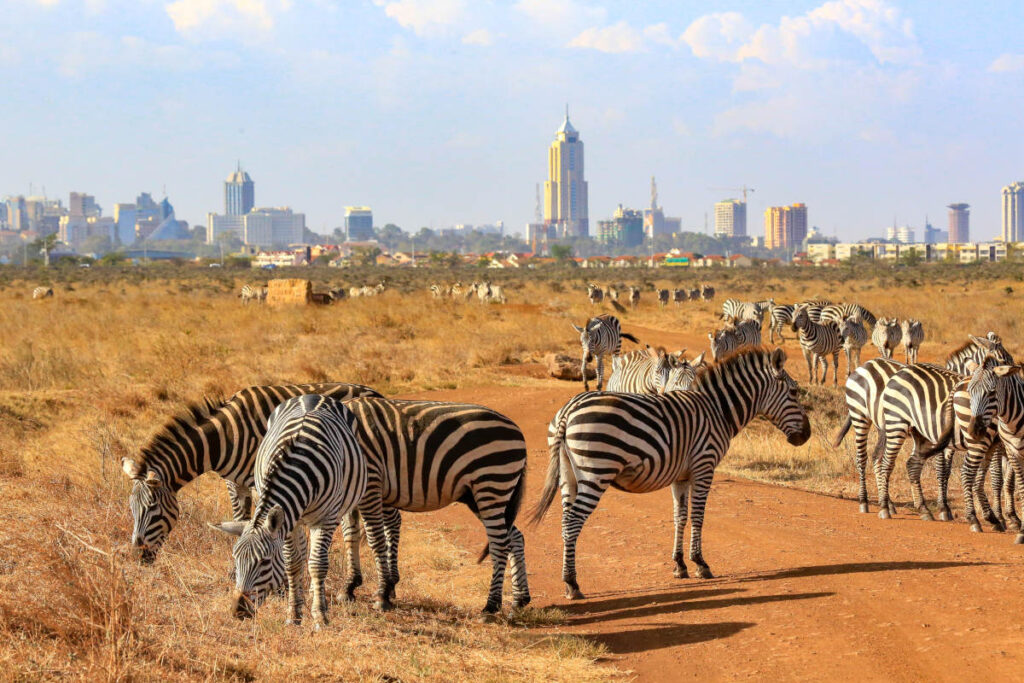
Nature, Wildlife and Adventure in Kenya
Imagine this: you’re watching a lion stretch lazily across a sun-baked boulder, her amber eyes half-closed in the afternoon heat. Behind her, not a savannah stretching to the horizon, but a glittering skyline. Glass towers. The hum of a city. Nairobi. It sounds like a painting. A dream, maybe. But it is absolutely, unmistakably real, and it is waiting for you, just seven kilometres from the heart of Kenya’s capital.
Welcome to Nairobi National Park. The only national park on earth where you can spot a black rhinoceros against a backdrop of skyscrapers. Where the wild and the urban coexist in a relationship so extraordinary, it has captured the imagination of travellers, conservationists, and storytellers for decades.
At Otter African Safaris, we’ve had the joy of introducing guests from around the world to this remarkable place. And every single time, every single time we watch that first moment of wonder unfold: the moment when a seasoned city traveller realises they are, without question, on safari.
The Park That Defies Expectation
Nairobi National Park covers 117 square kilometres of protected wilderness, small by African standards, yet bursting at the seams with life. Established in 1946, it holds the distinction of being Kenya’s first national park, and it remains one of the most densely wildlife-populated reserves on the continent relative to its size. The landscape shifts and breathes across the park. Open grass plains sweep into valleys threaded with dark acacia woodland. The Mbagathi River cuts a quiet path along the southern boundary, fringed by riverine forest thick with birdsong. During the long rains, the plains turn a vivid, aching green. In the dry season, the golden grass hums with insects and the air tastes of dust and possibility. It is, in every sense, wild Africa, just with a city as its neighbour.
The Wildlife: Who Will You Meet?
This is, of course, what every safari guest is waiting to hear about. And Nairobi National Park does not disappoint.
Lions are the park’s most celebrated residents. These are not habituated, sleepy big cats bred in captivity; these are free-roaming, apex predators living entirely wild lives. The park’s prides are well established, and a morning game drive frequently rewards patient visitors with sightings. There is something profoundly humbling about watching a pride move through the grass in single file, the cubs stumbling over one another, the dominant male pausing to scent the air, while the city rises silently behind them.
Leopards inhabit the park too, though true to their nature, they make themselves scarce. Spotting one often draped over a branch in the riparian forest, a kill wedged safely in the fork above, is a true privilege. One of those sightings guests speak about for years.
Cheetahs are a particular highlight. Nairobi National Park is home to a healthy cheetah population, and the open grass plains provide ideal conditions for watching these animals at full speed. To witness a cheetah hunt that explosive, breathtaking burst across the plain is to understand something about the natural world that no documentary can fully convey.
The park is also home to enormous herds of Cape buffalo, zebra, wildebeest, giraffe, eland, kongoni, impala, and warthog. Hippos are found along the Mbagathi River, largely concealed by day but unmistakable in the evenings. And Nairobi National Park is a stronghold for the critically endangered black rhinoceros, one of the most important populations in Kenya.
Birdwatchers, take note: over 400 species have been recorded in the park, making it a world-class birding destination. Ostriches stalk the plains. Martial eagles circle on thermals. Secretary birds pace through the grass like scholarly generals.
Sunrise Over the Plains: Why We Go at Dawn
There is a particular hour in Nairobi National Park that our guides at Otter African Safaris talk about reverently. It arrives just after five in the morning, when the sky ahead is still deep indigo, and the first suggestion of amber is lifting above the Ngong Hills to the west. The park gates open. The engine turns over. Everything is possible.
The animals are most active in these cool morning hours. Lions that will be resting by nine o’clock are still on the move, hunting or patrolling territories. Cheetahs are scanning the plains. Impala move in nervous, glittering herds. We always recommend that guests book the early morning game drive. There is nothing quite like it in the world, and that is not hyperbole. That is simply the truth of dawn on an African plain.
The Nairobi Animal Orphanage & Wildlife Conservation
Adjacent to the park’s main gate, the Wildlife Works and the Kenya Wildlife Service Nairobi Animal Orphanage offer an opportunity to get closer to animals that, for various reasons, cannot be released into the wild. It is a thoughtful addition to any Nairobi Park experience, particularly for families travelling with young children.
But the park itself is much more than a visitor attraction. It is a critical conservation corridor. During the dry season, wildlife migrates through the park’s open southern boundary, moving between the park and the wider Kitengela conservation area. This movement, ungulates threading between urban infrastructure and wild spaces,e is one of the most remarkable ongoing conservation stories in Africa, and it is one that Otter African Safaris is proud to support through partnerships with local conservation organisations.
When you safari with us, you are not simply a guest. You are part of an ecosystem of protection.
A Half-Day or Full-Day? Here’s What We Recommend
One of the questions we hear most often: How long should we spend in Nairobi National Park?
For visitors with limited time, those on a layover, a business trip extended by a day, or simply passing through Nairobi, even a half-day morning game drive delivers extraordinary value. You can be in the park by six, watching wildlife for four hours, and back at your Nairobi hotel in time for a late lunch. It is, without question, the most accessible Big Five experience in Africa.
For guests with more time, a full-day safari allows for the rhythms of the park to unfold completely. You’ll see the morning activity give way to the languid midday heat, and then the afternoon’s second surge as shadows lengthen, and the animals stir again. A picnic at the hippo pools. Sundowners at the park boundary with the city lights beginning to shimmer. It is a complete, unhurried experience.
Otter African Safaris offers tailored packages for both, with experienced guides who know the park’s roads, its resident animals, and its secrets. We also combine Nairobi National Park with visits to the David Sheldrick Wildlife Trust, where orphaned elephants are raised and rehabilitated, and the Giraffe Centre, creating a rich, conservation-focused Nairobi wildlife day that is entirely unlike anything else on offer in East Africa.
Getting Here Easier Than You Think
Nairobi National Park’s main gate is located on Langata Road, approximately 15 minutes from Nairobi’s central business district and 20 minutes from Jomo Kenyatta International Airport. This proximity makes it a genuinely seamless experience, with no long drives, no additional domestic flights. You land in Nairobi. You are, very nearly, already on safari.
For international visitors, Nairobi often serves as the gateway to Kenya’s broader safari circuit, the Maasai Mara, Amboseli, Tsavo, and Samburu. Nairobi National Park is a magnificent opening chapter to any of these journeys. An appetiser, if you will. Though for many guests, it turns out to be a great deal more than that.
Why Book With Otter African Safaris?
At Otter African Safaris, Kenya is not just where we work. It is where we live, where we grew up, and where our love for the natural world was born. Our guides bring years of field experience and a genuine, unscripted passion for the wildlife and ecosystems they share with you.
Our team believe that travel done right- travel that supports communities, funds conservation, and connects human beings to the wild world- changes people. We have watched it happen, safari after safari. And we would very much like it to happen to you.
Book Your Nairobi Safari Experience Today
Whether you have an afternoon or a full day, whether you’re a first-time safari-goer or a seasoned African traveller, Nairobi National Park will surprise you. It will move you. It will remind you, firmly and beautifully, that the wild world is closer than you think.
Contact Otter African Safaris to book your Nairobi National Park experience. We offer private game drives, group packages, family safaris, and combined Nairobi wildlife day tours throughout the year.
Contact us: info@otterafricansafaris.com or otterafricansafaris94@gmail.com
Visit: www.otterafricansafaris.com
Call: +256773945555 or +256773932802.
