
The Journey Between Uganda’s National Parks Is Part of the Adventure
October 28, 2026
Uganda’s Remote Wilderness
Imagine a safari where the only other vehicle you see all morning is your own reflection in a dried-up riverbed.
It’s early in the dry season, and the grass of the Narus Valley has turned the colour of honey. Your guide cuts the engine on a low rise. Ahead, a pride of lions lounges beneath a lone tree, cubs tumbling over each other, while on the far ridge a line of buffalo drifts like slow smoke. Beyond them, the jagged blue Lomej Mountains rise toward the South Sudan border. No crowds. No queues of minibuses. Just you, the wind, and the sense that you’ve wandered into a corner of Africa the brochures forgot.
Welcome to Kidepo Valley National Park, Uganda’s best-kept secret, and perhaps the most rewarding safari you haven’t yet taken.
A Wilderness at the Edge of the Map
Tucked into the far northeastern corner of Uganda, in the rugged Karamoja region, Kidepo sits close to the borders of South Sudan and Kenya. It spans roughly 1,400 square kilometres of open savannah, rocky hills and seasonal rivers. Because it is so far from Kampala, it sees only a fraction of the visitors who flock to Uganda’s western parks, and that is precisely its charm.
Travellers often tell us the same thing when they return: it felt like Africa before the crowds.
What You’ll See: Wildlife You Won’t Find Elsewhere in Uganda
Kidepo is a wildlife park with a personality all its own. The Narus Valley, with its permanent water holes, draws animals in numbers that surprise first-time visitors during the dry season.
Look for:
- Lions and leopards stalking the valley and rocky outcrops
- Cheetahs, rarely seen elsewhere in Uganda, hunting across the open plains
- Elephants and buffalo in large herds
- Rothschild’s giraffes, Burchell’s zebras and elands grazing the grasslands
- Ostriches, caracals and striped hyenas, a trio that feels pleasantly exotic for East Africa.
Birdwatchers are in for a treat too. With hundreds of recorded bird species, including many raptors and dry-country specialists you won’t tick off in the south, Kidepo is a serious contender for any serious birder’s wish list.
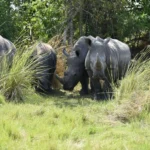
One honest note: Kidepo has no rhinos, so it isn’t a “Big Five” park. What it offers instead is something many travellers value even more: space, silence and the thrill of having a sighting entirely to yourself.
More Than Wildlife: The People of Karamoja
A trip to Kidepo isn’t only about animals. The surrounding Karamoja region is home to the proud, pastoral Karamojong people, whose tall, dome-shaped homesteads, cattle culture and vivid beadwork have endured for generations. A guided visit to a manyatta (traditional settlement) lets you hear stories, watch dances and understand life in one of Uganda’s most distinctive cultural landscapes.
You can also arrange a guided trek into the Morungole Mountains to meet the Ik community, one of East Africa’s smallest and most resilient peoples. These visits are best done thoughtfully and with a trusted local guide, which is exactly the kind of experience Otter African Safaris is built to arrange respectfully.
Beyond the Game Drive
Kidepo rewards the curious. Between sunrise and sunset drives, you can:
- Walk with a ranger across the Narus Valley, feeling the scale of the savannah on foot.
- Soak in the Kanangorok Hot Springs, near the Sudan border, a rewarding excursion for the adventurous.
- Climb to a viewpoint at golden hour for a panorama that stretches to the horizon.
- Sip a sundowner while the sky turns amber, then fall asleep to the distant whoop of hyenas.
Getting There: Is the Journey Worth It?
Let’s be straightforward: Kidepo takes effort. The overland drive from Kampala is long, often a full day or more depending on your route and stops, though the journey itself, through Karuma Falls, Gulu and the dramatic Karamoja landscapes, is part of the adventure.
For travellers short on time, a scheduled or chartered flight from Entebbe or Kajjansi to Kidepo’s airstrip cuts the journey to around two hours and delivers some spectacular aerial views as a bonus. Many of our clients combine the two: drive one way for the scenery, fly the other for the convenience.
When to Go?
The dry seasons, generally December to February and again from around June to September, are the most rewarding for wildlife, as animals concentrate around the remaining water in the Narus Valley. The green season brings lush landscapes, dramatic skies and excellent birding, with quieter trails and a more serene atmosphere.
So, Is Kidepo Right for You?
Kidepo is perfect if you:
- Crave solitude and wide-open landscapes.
- Love photography, big skies and uncrowded sightings.
- Want culture and wildlife in the same trip.
- Have returned to Africa before and want something new
- Enjoy a sense of true remoteness.
You might prefer another park if you:
- Need a short, easy road trip from Kampala.
- Are chasing rhinos or gorillas specifically (we’d happily suggest Ziwa Rhino Sanctuary or Bwindi or Mgahinga for that)
- Prefer a polished, resort-style setting over a rugged, remote one.
And remember: Kidepo pairs beautifully with other Ugandan highlights. Imagine tracking gorillas in Bwindi, cruising the Kazinga Channel, then finishing your journey with the wild silence of Kidepo. It’s a full portrait of Uganda in a single itinerary.
Let Otter African Safaris Write Your Kidepo Story
As a Uganda-based operator with tailor-made journeys across Uganda, Rwanda, Kenya and Tanzania, we know the quiet corners of this region intimately. We handle the logistics that make remote travel effortless: flights or road transfers, lodges and camps, local guides, cultural visits and every detail in between, so you can simply look up and take it all in.
If your idea of adventure is a place where the horizon belongs to you, Kidepo is waiting.
Ready to explore Uganda’s remote wilderness? Contact Otter African Safaris today and let’s design your Kidepo adventure. Call 0773932802 or 0773945555.


